







George Washington University Athletics
Transformation of a Champion
4/24/2017 12:00:00 AM | Men's Golf
By Justin Moore, GW Athletics Communications
Ask any golfer who's had success in tournament play to tell you about their first win, and you're sure to be greeted by a big grin.
Winning a golf tournament is inherently difficult, but winning for the first time? It represents a hurdle that many collegians -- even some who go on to play professionally -- don't clear.
Logan Lowe came into the spring season of his sophomore year with an already sparkling resume: his debut season at GW included five top-20 finishes, four A-10 Rookie of the Week honors, a 73.31 scoring average that led the team, and he was the only freshman that landed a spot on the All-Atlantic 10 Golf team.
Still, it was missing a victory. A tie for sixth at the Elon Invitational in October was, at the time, the best finish of his career but still a disappointment. Lowe opened the tournament on fire, carding a 67 and 66 to get to 9-under par and one shot off the lead after the first day, before closing with a final round 74 that left him out of contention.
Looking back, Lowe doesn't blame the disappointing final round on anything technical - not a few missed putts, an off-target driver, or a faulty wedge game - but to something larger.
"It was a really tough one for me to swallow because I was so hot the first day, and I just didn't feel like I could get anything going the second day," said Lowe. "Honestly though, I don't think I was ready to win then. I just don't think I had the right approach to win that day."
At 10 years old, Lowe, a native of Grass Valley, California, was victorious at a golf tournament for the first time, a win he describes to this day as his favorite. Playing in the Chico Junior Classic at Butte Creek Country Club in Northern California, a course his grandfather helped found, Lowe was a shot back entering the final round.
On his first hole of the day, Lowe made eagle to vault into the lead, and never looked back in holding on for the victory.
"For me," Lowe says, "that was when I figured out how to win, because I had the lead all day."
A year later, at the age of 11, he became the youngest player to win his junior club championship. Some nerves presented themselves when, standing on the first tee, Lowe found himself playing against teenagers.
Winning the Chico Junior Classic was special to Lowe because of the family history and his ability to maintain a lead through the course of a final round. That, and his club championship victory a year later when staring down older, more physically matured competitors, were big steps forward in his career. Having the confidence to know he could compete and win tournaments helped provide the foundation for future success. Eight years later, however, it would be in defeat that Lowe would take a next step forward at the collegiate level.
Just five days after his final round 74 at Elon, Lowe and GW competed in one more tournament in the fall, the Old Dominion Invitational, with Lowe finishing tied for 28th. With a more than four-month break from competitive golf, Lowe got busy hatching a plan on how to attack the spring season.

Looking to transform his approach to a round, Lowe sought out advice from other golfers about how they handled being in the position to win, and through those conversations came to a simple, but important revelation.
"As cliché as it is, it's just another round," said Lowe. "I still have my same game plan. That's probably the biggest thing that's changed for me; I have a very specific game plan every time I step on the course."
Before a tournament, Lowe will map out the entire course, picking holes he believes he should make birdie and figuring out the ones where par is a good score. He'll have an idea, based on factors such as wind, what club he's likely to use off the tee, giving him a set strategy that helps ease the mental grind of tournament golf.
Having an entire round mapped out makes it easier to deal with mistakes, which are inevitable in golf. A bogey is much easier to stomach when you know you have a hole coming up that you've identified as one you are more than capable of making birdie.
"I had so much anxiety because I was in contention and knew I could make birdies, but I didn't have it mapped out in my mind," said Lowe, speaking of the tournament at Elon. "I had a tough start and I didn't have it in my head, `well I still have this hole, this hole and this hole to make that up and more.' So I think that was the biggest change for me after that event and heading into the spring, that I know exactly what I'm going to do at the course."
In addition to the tactical change, Lowe and the rest of his teammates set out to improve their physical capabilities on the golf course. Coming into his sophomore year weighing 150 pounds, Lowe looked to some of the best golfers in the world who have made fitness a priority, and knew he needed to add weight to his frame.
Under the guidance of GW strength and conditioning coach Colin Kidwell, Lowe went through three team lifts a week, and an additional two on his own, while beginning a diet heavy on protein shakes that he estimates had him taking in 3,000 to 4,000 calories a day.
Lowe added 15 pounds of muscle in a few months, giving him an extra 5-10 yards off the tee but most importantly, he says, more control of his body and club and a bigger energy reserve in crunch time at the end of a round.
"Swinging as fast as we do, and me only weighing 150 pounds, that left a lot of variables that I can't control with my body turning that fast," said Lowe. "There were some things that I just couldn't control."
With a renewed sense of confidence, Lowe headed into the spring season knowing he had what it took to win on the collegiate level.
GW's first stroke play competition of the spring was March 13th and 14th at the Bash at the Beach Invitational in Myrtle Beach, South Carolina. Playing at the par 71, 6,741-yard, Surf and Golf Beach Club, steady rain fell throughout the first day of competition, and just two players in the 96-man field managed to shoot under par.
Lowe shot an opening-round 73 in the morning, followed by an even-par 71, and his 2-over par total stood four shots back of the lead heading into the final 18 holes. It was not an insurmountable deficit, but just a few months prior Lowe might've let the frustration of his first two rounds creep in and derail his chances. Instead, he stuck with his process, knowing that his best effort in the final round would put him in contention to win.
Prior to teeing off, Lowe surveyed the conditions and sized up the field. It was cold, and the wind was blowing hard. Just two players were in red figures the day before; a low number in the final round could vault him up from his starting position of tied for eighth. He retraced the plan he put in place before the tournament, picking out holes he felt he could birdie, and others where he would take par and move on.
Starting his day on the 493-yard, par 5 No. 1, Lowe had birdie in mind. He hit a hard, drawing driver over the dogleg left, leaving him with a hybrid approach shot that he hit to 22 feet. He lagged his eagle putt up to a foot and a half, and tapped in for a birdie start. From there, Lowe ripped off 15 consecutive pars while the field around him struggled in the difficult conditions. By the time he reached the par-5 17th, Lowe sensed he might be near the lead, and responded with his second birdie of the day to get to even par for the tournament.
On the final hole, Lowe made his 16th par of the day on a 206-yard par 3 to turn in a final round 69, one of just three scorecards on the day that was below 70. The perfectionist in Lowe wasn't all together happy with his final round - he can think of four birdie putts inside 13 feet that lipped out or burned the edge - and he walked off the final green `fuming' before his teammates told him that he had, in fact, won his first collegiate tournament. Channeling his frustration to the end of a round, rather than in the middle of it, proved to make all the difference. The hurdle had been cleared with a clutch final round that didn't include a single bogey - the only player in the field with a clean scorecard.
"It's such a mental game and it's so hard to stay in the moment," said Lowe. "It's most satisfying when you actually do it. I didn't get frustrated during the final round. It was more after the fact, right when you get the final putt in, it kind of hits me all at once; `why'd you do that, what were you doing over here?'"
"A lot of the time last fall, he would get in position and allow one mistake to derail his chances to win," added head coach Chuck Scheinost. "He'd end up making a mistake that he thought cost him a chance to go from leading to not leading, and would keep that with him for a few holes. That's something he's worked on; mentally letting those moments go."
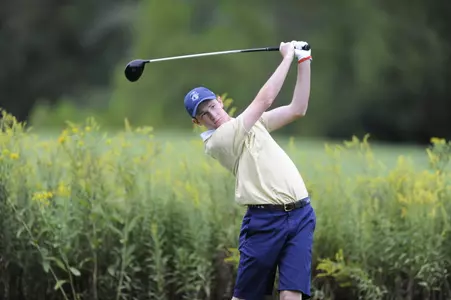
Lowe turned in a splendid final round to win the Bash at the Beach
Heading into the Atlantic 10 Championship this weekend, Lowe will bring his new approach to a familiar place, as the event returns to Grand Cyprus Golf Club in Orlando, Florida, starting Friday. As a freshman last year, Lowe was tied for third and two shots off the lead heading into the final round before finishing 13th.
The lessons he's learned this year have him well-equipped to compete again; Lowe has been in contention to win at three of the four stroke play events in the spring despite, he says, not always playing the golf he believes he's capable of playing.
"There's still another gear he can find," said Scheinost. "He's starting to figure out he can compete in and win golf tournaments without playing his best. What's going to happen when he starts playing to his form?"


