



George Washington University Athletics
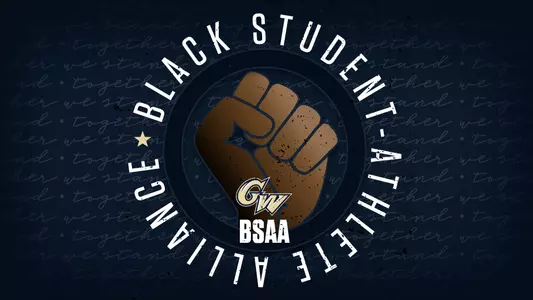
Making Their Voices Heard
12/17/2020 12:00:00 PM | General, Women's Track/Cross Country, Gymnastics, Women's Soccer, Women's Volleyball
New BSAA aims to uplift and unite
When Alexis Williams called to order the first meeting of the GW Black Student-Athlete Alliance last month, it was the realization of a vision more than two years in the making.
Amid a national awakening to systemic racism and police brutality against the Black community, Williams sought to join the conversation. The GW women's soccer senior found a way to make her voice heard in renewing efforts to bring to life an idea that had been on her mind since her sophomore year.
"I just couldn't stay silent after everything that happened," Williams said. "The Black Lives Matter movement, George Floyd, everything. Personally, I just could not do it."
Thanks to the hard work of Williams and an executive board that includes Paz Dozie-Nnamah (volleyball), Maya White (track), Melody Williams (volleyball) and Deja Chambliss (gymnastics), the BSAA, billed in its constitution as "a platform to uplift the Black voices within the GW athletic community," received status as a student organization on campus this fall.
More than a dozen student-athletes joined the initial Webex call last month for frank conversation about a variety of important topics as well as planning for how the group can make an impact on campus and beyond moving forward.
"There are just some things that Black athletes experience that other athletes don't," Dozie-Nnamah said. "We felt it was important to have a safe space for black athletes to come to and share experiences and have discussions and just get to know who each other are."
Leading the way as the organization's first president, Alexis Williams was pleased to see so many people, including staff advisors Torrie Browning and Shatara Stokes and a group of supportive administrators, enthusiastically embracing that vision.
"I don't even have words to describe it," Williams said. "It was just beautiful to see everyone come together to support Black athletes. I think it's showing that the athletic department is taking steps in the right direction and making it even more of an inclusive and a together environment."
Back in the spring amid the rise of the Black Lives Matter movement in response to a series of startling incidents of police violence against Blacks, GW's Black student-athletes, coaches and staff gathered for a series of conversations facilitated by Dr. Jordan West, director of GW's diversity & inclusion programming.
It was enlightening to bring everyone together, albeit virtually, during that difficult time.
"We realized a lot of the black student-athletes here didn't actually know each other," Melody Williams remembered. "We'd see each other in the hallway, but we couldn't say that we're friends. There wasn't a sense of community. I think that's what we really wanted and what we really needed at this time."
For Alexis Williams, it was confirmation that the timing was right to start a Black student-athlete organization in Foggy Bottom. The New Jersey native had been interested in starting one since a friend at Amherst College shared her experience in a similar group.
She knew first-hand how difficult it can be to make connections outside of your team for a busy student-athlete, a challenge that can be even more difficult for a Black student-athlete on a predominantly white campus. She believed it could help bridge the gap to other Black student orgs on campus, as well.
"There's not that many of us," Williams said. "We should be able to go to each other and say 'Hey.'"
With the endorsement of the GW Athletics Diversity, Equity and Inclusion Task Force and help every step of the way from Browning and Stokes, Williams and her team of fellow volunteers got to work this fall putting together the pieces to gain student-org approval.
The process included drafting an organizational constitution and mission statement and preparing a presentation for the Office of Student Life's New Organizations Committee.
In an unprecedented semester, the group needed careful planning and patience to navigate the process step-by-step utilizing Zoom and FaceTime, but they were able to get it done together.
"There was a lot of trial and error, but it was exciting to see that we were getting somewhere and figuring out things," Dozie-Nnamah said. "I think we worked really well together. It wasn't just one person doing most of the work."
At the end of a busy semester, the BSAA's first full body meeting marked a meaningful milestone for the members of the executive board.
They relished the steady conversation about everything from the Black Lives Matter logo on the court at Smith Center to diversity within the department to planning for the spring semester.
"I was pleasantly surprised at how much we all have in common and how much our thoughts are the same," said White, who is active in GW's Black Student Union. "You just don't know how other people feel until they share it.
Hearing people share their thoughts and their enthusiasm for the future definitely showed that we're all pretty much on a similar page."
The first community service project is already underway as the BSAA is teaming with Black student-athlete groups at American and Georgetown on a holiday fundraising drive to help provide D.C. families with toys and health supplies. (Donate here.)
While the continued pandemic makes the spring semester uncertain, the group has hopes to focus community service efforts on underserved areas of D.C. and take part in events that highlight the city's rich Black culture when it is safe again.
Together, they aim to make their voices heard.
"I'm excited to see where it goes," said Dozie-Nnamah, who serves as the BSAA's vice president. "It's important that it's an organization that we keep going, especially for possible recruits. We want Black athletes to know that there is a safe space here."
Amid a national awakening to systemic racism and police brutality against the Black community, Williams sought to join the conversation. The GW women's soccer senior found a way to make her voice heard in renewing efforts to bring to life an idea that had been on her mind since her sophomore year.
"I just couldn't stay silent after everything that happened," Williams said. "The Black Lives Matter movement, George Floyd, everything. Personally, I just could not do it."
Thanks to the hard work of Williams and an executive board that includes Paz Dozie-Nnamah (volleyball), Maya White (track), Melody Williams (volleyball) and Deja Chambliss (gymnastics), the BSAA, billed in its constitution as "a platform to uplift the Black voices within the GW athletic community," received status as a student organization on campus this fall.
More than a dozen student-athletes joined the initial Webex call last month for frank conversation about a variety of important topics as well as planning for how the group can make an impact on campus and beyond moving forward.
"There are just some things that Black athletes experience that other athletes don't," Dozie-Nnamah said. "We felt it was important to have a safe space for black athletes to come to and share experiences and have discussions and just get to know who each other are."
Leading the way as the organization's first president, Alexis Williams was pleased to see so many people, including staff advisors Torrie Browning and Shatara Stokes and a group of supportive administrators, enthusiastically embracing that vision.
"I don't even have words to describe it," Williams said. "It was just beautiful to see everyone come together to support Black athletes. I think it's showing that the athletic department is taking steps in the right direction and making it even more of an inclusive and a together environment."
Back in the spring amid the rise of the Black Lives Matter movement in response to a series of startling incidents of police violence against Blacks, GW's Black student-athletes, coaches and staff gathered for a series of conversations facilitated by Dr. Jordan West, director of GW's diversity & inclusion programming.
It was enlightening to bring everyone together, albeit virtually, during that difficult time.
"We realized a lot of the black student-athletes here didn't actually know each other," Melody Williams remembered. "We'd see each other in the hallway, but we couldn't say that we're friends. There wasn't a sense of community. I think that's what we really wanted and what we really needed at this time."
For Alexis Williams, it was confirmation that the timing was right to start a Black student-athlete organization in Foggy Bottom. The New Jersey native had been interested in starting one since a friend at Amherst College shared her experience in a similar group.
She knew first-hand how difficult it can be to make connections outside of your team for a busy student-athlete, a challenge that can be even more difficult for a Black student-athlete on a predominantly white campus. She believed it could help bridge the gap to other Black student orgs on campus, as well.
"There's not that many of us," Williams said. "We should be able to go to each other and say 'Hey.'"
With the endorsement of the GW Athletics Diversity, Equity and Inclusion Task Force and help every step of the way from Browning and Stokes, Williams and her team of fellow volunteers got to work this fall putting together the pieces to gain student-org approval.
The process included drafting an organizational constitution and mission statement and preparing a presentation for the Office of Student Life's New Organizations Committee.
In an unprecedented semester, the group needed careful planning and patience to navigate the process step-by-step utilizing Zoom and FaceTime, but they were able to get it done together.
"There was a lot of trial and error, but it was exciting to see that we were getting somewhere and figuring out things," Dozie-Nnamah said. "I think we worked really well together. It wasn't just one person doing most of the work."
At the end of a busy semester, the BSAA's first full body meeting marked a meaningful milestone for the members of the executive board.
They relished the steady conversation about everything from the Black Lives Matter logo on the court at Smith Center to diversity within the department to planning for the spring semester.
"I was pleasantly surprised at how much we all have in common and how much our thoughts are the same," said White, who is active in GW's Black Student Union. "You just don't know how other people feel until they share it.
Hearing people share their thoughts and their enthusiasm for the future definitely showed that we're all pretty much on a similar page."
The first community service project is already underway as the BSAA is teaming with Black student-athlete groups at American and Georgetown on a holiday fundraising drive to help provide D.C. families with toys and health supplies. (Donate here.)
While the continued pandemic makes the spring semester uncertain, the group has hopes to focus community service efforts on underserved areas of D.C. and take part in events that highlight the city's rich Black culture when it is safe again.
Together, they aim to make their voices heard.
"I'm excited to see where it goes," said Dozie-Nnamah, who serves as the BSAA's vice president. "It's important that it's an organization that we keep going, especially for possible recruits. We want Black athletes to know that there is a safe space here."
Players Mentioned

All-Around
/ Gymnastics
OH
/ Women's Volleyball
Sprints
/ Women's Track/Cross Country
Midfield
/ Women's Soccer
MB
/ Women's VolleyballThursday, May 21
Thursday, May 21
Thursday, May 21
Thursday, May 21